
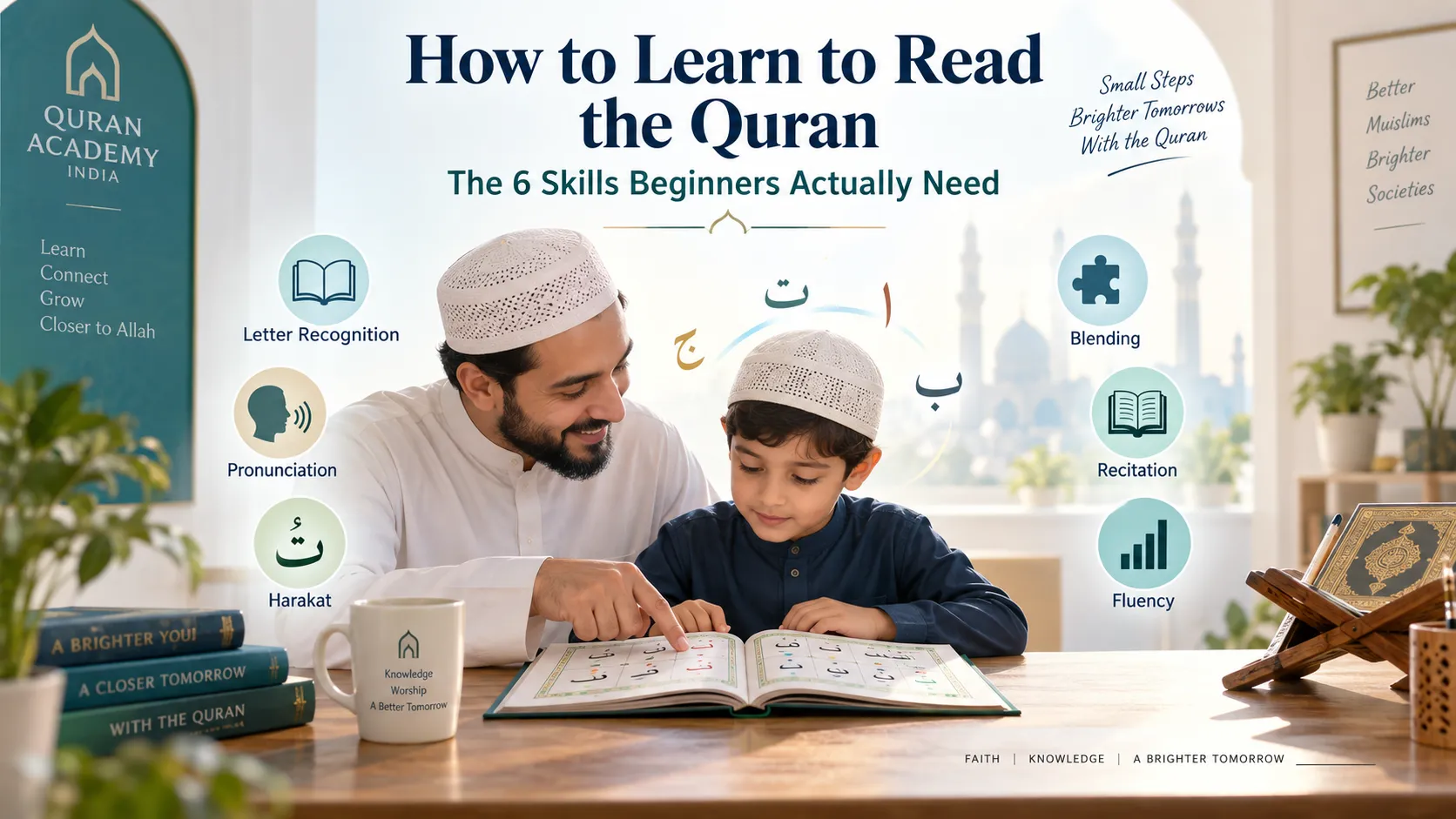
Learning to read the Quran is often explained as a simple sequence:
Learn the Arabic alphabet → finish Qaida → start reading the Quran → learn Tajweed.
That sequence is useful, but it hides something important.
A person can know every Arabic letter and still struggle to read a word.
Another learner may read quickly but repeatedly pronounce certain letters incorrectly.
Someone else may have completed a Qaida years ago but hesitate whenever they open an unfamiliar page of the Quran.
These learners do not have the same problem.
Learning to read the Quran is not one skill. It is a combination of visual recognition, listening, pronunciation, decoding, blending and fluent recitation.
Understanding which of these skills needs work makes Quran learning much clearer—for a complete beginner, an adult returning after many years, or a parent trying to understand a child’s progress.
The Short Answer
A complete beginner learns to read the Quran by developing six connected skills:
- Recognising Arabic letters in their different forms
- Producing the correct sound of each letter
- Reading vowel marks and other Quranic signs
- Joining sounds together without guessing
- Applying correct pronunciation and basic recitation principles
- Reading unfamiliar Quranic text accurately and increasingly fluently
The important point is this:
Finishing pages is not the same as mastering these skills.
A learner should move forward when what they have learned begins to transfer to text they have not memorised before.
What Does “I Can Read the Quran” Actually Mean?
People use this phrase in very different ways.
A parent may say:
“My child knows the Qaida.”
But what exactly does that mean?
Can the child:
- recognise individual Arabic letters?
- recognise the same letters when joined?
- read Fathah, Kasrah and Dammah?
- pronounce the letters correctly?
- combine the sounds independently?
- read an unfamiliar Quranic word?
- read directly from the Mushaf?
- read fluently?
- recite with Tajweed?
These are separate abilities.
A better question than:
“Which page has the learner reached?”
is:
“What can the learner now do independently that they could not do before?”
That is a much more useful way to measure progress.
The Six Skills Behind Quran Reading
Skill 1: Recognising the Letter, Not Just Memorising Its Name
The first stage is visual recognition.
A beginner must be able to look at an Arabic letter and identify it reliably.
But Arabic letters do not always look identical.
Many letters change shape depending on whether they appear:
- alone,
- at the beginning of a word,
- in the middle,
- or at the end.
Several letters also share almost the same basic shape.
For example:
ب ت ث
are largely distinguished by their dots.
A beginner who confidently recognises ب on an alphabet chart may still fail to recognise it inside connected Arabic text.
That is not necessarily a memory problem.
The learner has simply not yet learned to recognise the letter across different visual contexts.
A stronger test is therefore not merely:
“What letter is this?”
Instead, show the same letter:
- alone,
- joined to another letter,
- surrounded by visually similar letters,
- and inside a word the learner has never practised.
Recognition should eventually survive all of these changes.
Skill 2: Knowing a Letter Is Not the Same as Pronouncing It
This is one of the most important distinctions in Quran learning.
A learner may correctly identify:
ح
as Haa
while still producing the wrong sound.
Why?
Because Quran reading is not purely visual.
Your eyes identify the symbol.
Your ears learn what that symbol should sound like.
Your tongue, lips, throat and mouth then have to reproduce that sound.
This is where makhārij al-hurūf, the articulation points of the Arabic letters, become important.
Some Arabic sounds do not have a direct equivalent in English, Hindi, Urdu or many other languages.
That is why learners may confuse letters such as:
| Letters | Common beginner difficulty |
|---|---|
| س / ص | Both may initially sound like an ordinary “s” |
| ت / ط | The heavier quality of ط may disappear |
| د / ض | The learner may not distinguish their articulation |
| ه / ح | Both may initially be treated as an English-like “h” |
| ك / ق | The deeper articulation of ق may be lost |
| أ / ع | Transliteration can make the difference seem smaller than it really is |
The important principle is:
Learn the sound together with the letter.
A beginner does not need an advanced Tajweed textbook on the first day.
But establishing an obviously incorrect sound and trying to repair it years later is unnecessary.
Skill 3: Understanding What the Marks Around a Letter Do
Once the letters become familiar, the learner must understand the marks attached to them.
Consider:
بَ
بِ
بُ
The letter remains the same.
The sound changes because of the vowel mark.
A beginner gradually learns elements such as:
- Fathah
- Kasrah
- Dammah
- Tanween
- Sukoon
- Shaddah
- Madd
An experienced reader processes these signs almost automatically.
A beginner does not.
For a beginner, even a short combination can require several mental decisions:
Which letter is this?
Which mark is attached to it?
What sound does that produce?
What comes after it?
This explains why beginners often read slowly.
Slow reading does not automatically mean poor learning.
The learner’s brain is still performing consciously what an experienced reader eventually performs almost instantly.
Skill 4: Blending the Sounds Together
This is where many learners quietly become stuck.
A student may know:
ب
ت
ك
individually.
But knowing the letters individually does not automatically mean the learner can read them correctly when they appear inside a connected word.
At first, the learner sees:
letter → letter → letter
With practice, the brain gradually begins recognising:
sound combination → pattern → word
This is called blending.
A common sign of a blending problem is that the learner can read every letter correctly when a teacher points to them separately but becomes confused when the same letters appear together.
That learner may not need to relearn the alphabet.
They need practice combining known sounds.
This distinction matters because repeatedly teaching something the student already knows can make Quran lessons frustrating without solving the real problem.
Skill 5: Reading the Word Correctly Is Not the End of Recitation
Eventually the learner can decode a written Quranic word.
That is an important milestone.
But Quran recitation contains another layer.
The learner must increasingly pay attention to how the sound is produced and carried through the recitation.
This gradually includes:
- correct makhraj,
- characteristics of letters,
- heavy and light sounds,
- elongation,
- nasalisation,
- doubled letters,
- stopping correctly,
- and other Tajweed principles.
Allah says:
“And recite the Quran with measured recitation.”
— Quran 73:4
This does not mean a complete beginner needs to memorise every Tajweed rule before being allowed to read.
A more natural learning sequence is often:
hear → imitate → practise → recognise → understand the rule
A child may learn to pronounce something correctly before knowing the Arabic technical term describing what they are doing.
That is perfectly reasonable.
Skill 6: Transfer — Can You Read Something You Have Never Practised?
This may be the most important skill of all.
Suppose a child reads one Qaida exercise beautifully.
Now show the child a different line containing the same principles but different letter combinations.
Can they still read it?
If not, they may have learned the exercise without fully learning the underlying skill.
This gives us a much better way of measuring Quran reading progress.
A Better Way to Measure Progress: Accuracy, Latency and Transfer
Instead of judging Quran learning entirely through completed pages, look at three things.
Accuracy
Can the learner read the item correctly?
A learner who reads slowly but accurately may be progressing better than someone who reads rapidly while guessing.
Accuracy should generally come before speed.
Latency
How long does it take the learner to produce the answer?
At the beginning, a child may stare at a letter for five seconds before remembering it.
Later, the same letter may be recognised immediately.
Nothing about the letter has changed.
The learner’s processing has become more automatic.
That reduction in hesitation is genuine progress.
Transfer
Can the learner use the skill somewhere new?
A student who truly understands a reading pattern should gradually recognise it in:
- a new Qaida exercise,
- an unfamiliar word,
- another page,
- and eventually directly in the Mushaf.
This leads to an important principle:
The goal of Qaida is not to become good at Qaida.
The goal is to prepare the learner to read the Quran.
Where Are You Actually Stuck?
Many Quran learners say:
“I can’t read properly.”
That description is too broad to be useful.
The learner may actually have only one weak link.
For example:
| What happens when you try to read? | Likely skill needing attention |
|---|---|
| I cannot reliably identify the letters | Letter recognition |
| I know letters individually but lose them when they join | Joined-form recognition |
| I know the letter but my pronunciation is repeatedly corrected | Makhraj |
| I confuse the vowel marks | Harakat decoding |
| I can sound out individual letters but cannot combine them | Blending |
| I can read Qaida exercises but struggle with unfamiliar text | Transfer |
| I read accurately but extremely slowly | Automaticity / fluency |
| I read quickly but repeatedly make mistakes | Accuracy |
| I can read but some letters still sound almost identical | Sound discrimination |
| I understand Tajweed rules but forget them while reciting | Rule application |
| I used to read Quran but now hesitate constantly | Fluency recovery |
| I read Urdu comfortably but Arabic pronunciation feels difficult | Arabic-specific articulation |
The correct response depends entirely on the problem.
Someone with a makhraj problem does not necessarily need to relearn the Arabic alphabet.
Someone with a blending problem may not need more pronunciation lessons.
Someone who reads accurately but slowly may simply need repeated guided reading.
Diagnose before restarting.
That can save months of unnecessary repetition.
A Special Note for Learners Who Already Read Urdu
This is particularly important for many learners in India.
Someone who reads Urdu is not starting from the same point as a person who has never encountered Arabic script.
An Urdu reader may already:
- read right to left,
- recognise many Arabic-origin letters,
- understand connected script,
- recognise familiar Quranic vocabulary,
- and feel visually comfortable with an Arabic page.
That is a genuine advantage.
But it creates a particular challenge.
The eyes may be ahead of the mouth.
Some letters that remain distinct in Quranic Arabic have merged or substantially changed pronunciation in Urdu.
For example, an Urdu reader may visually distinguish several Arabic letters while instinctively giving them a familiar Urdu pronunciation.
This can affect letters such as:
ث، ذ، ص، ض، ط، ظ
among others.
So an Urdu-speaking adult may not need weeks of basic alphabet recognition.
They may instead need focused work on:
- hearing Arabic sound contrasts,
- finding the correct makhraj,
- retraining familiar pronunciation habits,
- and applying those sounds while reading.
This is why a good Quran programme should assess what the learner already knows instead of automatically placing every beginner on the same first page.
Should a Beginner Start with Noorani Qaida?
For many learners, a Qaida provides an effective structured route from recognising letters towards reading Quranic text.
But the Qaida itself is not the objective.
A strong Qaida programme should progressively develop:
recognition → pronunciation → decoding → blending → transfer
rather than simply moving from one numbered lesson to another.
This is why:
“How long will it take to finish Qaida?”
is not always the most useful question.
A better question is:
“What should the learner be able to do after finishing Qaida?”
Ideally, opening the Quran should feel like the next stage of the same skill—not like starting an entirely different subject.
How Do You Know When Someone Is Ready to Move from Qaida to the Quran?
Instead of relying only on whether the final Qaida page has been completed, test the learner’s abilities.
Can the learner recognise letters quickly?
Including when they appear in unfamiliar combinations?
Can the learner recognise joined forms?
Without needing every letter separated first?
Can the learner read common vowel marks correctly?
Without guessing from memory?
Can the learner blend?
Without treating each letter as a disconnected sound?
Is basic pronunciation reasonably established?
Especially for commonly confused letters?
Can the learner attempt an unfamiliar Quranic word?
Even if they read it slowly?
A learner does not need perfect fluency before touching the Quran.
They need enough foundational skill for actual Quran reading to become productive practice.
The Prophet ﷺ taught that the person who recites the Quran while finding it difficult and struggling with it receives two rewards.
— Sahih Muslim 798
Difficulty itself should therefore not make a learner feel embarrassed.
Should Beginners Use Transliteration?
Transliteration can occasionally help someone recognise how a word may sound.
But it should not become the learner’s main reading system.
Why?
Because Latin letters cannot reproduce every Arabic sound properly.
Writing:
s
and:
ṣ
may indicate that two sounds differ.
But it cannot teach the tongue how ص is actually articulated.
Likewise, no English spelling can fully teach someone how to produce:
ع
Transliteration can describe a sound.
It cannot replace hearing and producing it.
The long-term reading pathway should therefore become:
Arabic script → correct sound
not:
Arabic script → transliteration → approximate sound
Can You Learn Quran from an App or YouTube?
Digital tools can be extremely useful for Quran learning.
They can help learners:
- hear letters repeatedly,
- replay difficult sounds,
- practise recognition,
- revise independently,
- listen to recitation,
- and build a daily practice habit.
But technology has one major limitation.
A recording can demonstrate the correct sound. It may not know what you personally are doing incorrectly.
You can listen to ق one hundred times.
If you continue producing the wrong articulation, the recording may never tell you:
“Your sound is coming from the wrong place.”
This is the difference between input and feedback.
Technology provides excellent input.
A capable teacher provides personalised feedback.
A strong learning system can therefore combine:
teacher guidance + independent digital practice
rather than treating them as competing approaches.
Children and Adults May Need Different Learning Methods
The reading skills remain similar.
The teaching method does not have to.
Children
Children often benefit from:
- short exercises,
- frequent repetition,
- strong audio modelling,
- visual variety,
- gradual difficulty,
- immediate correction,
- and encouragement without excessive pressure.
One important caution is that children can become extremely good at memorising repeated exercises.
That can create the appearance of reading ability.
Showing unfamiliar examples helps reveal whether they are actually decoding the text.
Adults
Adults bring different strengths.
They can often understand explanations such as:
“The tongue should touch here.”
or:
“You are replacing this Arabic sound with the closest sound from your own language.”
Adults may also recognise patterns faster.
However, adults sometimes carry pronunciation habits that have existed for decades.
An adult who learned Quran reading as a child may therefore not need to restart from zero.
They may simply need to identify the specific reading skills that have weakened.
A Better 15-Minute Practice Session
Practice does not always mean reading as many lines as possible.
A beginner can divide a short practice session into three different types of work.
Five Minutes: Ear and Mouth
Listen to a small group of sounds.
Repeat them carefully.
Compare commonly confused letters.
Pay attention to where the sound is being produced.
Five Minutes: Eyes and Decoding
Read letters, vowel combinations or short patterns.
Avoid depending entirely on memorised examples.
Five Minutes: Transfer
Attempt something new.
Use the same skill in:
- another combination,
- a new word,
- or an unfamiliar short Quranic example.
This third stage tells you whether the learning is transferring.
For younger children, the session can be shorter.
The principle matters more than the exact number of minutes.
Five Mistakes That Can Slow Down Quran Learning
Treating Finishing the Book as the Goal
Qaida is a tool.
The ability to read Quran is the goal.
Correcting Pronunciation Too Late
Basic Arabic sounds should begin developing alongside letter recognition.
Measuring Progress Only Through Speed
Fast, inaccurate reading is not meaningful fluency.
Repeating the Same Examples Until They Are Memorised
Use unfamiliar combinations occasionally to test whether the learner understands the underlying reading pattern.
Restarting Everything When Only One Skill Is Weak
Identify the broken link.
Fix that skill.
Do not automatically rebuild the entire learning journey.
So What Is the Best Way to Learn to Read the Quran?
For a complete beginner, a strong progression looks something like this:
See the letter
↓
Recognise it wherever it appears
↓
Hear the correct sound
↓
Learn how that sound is produced
↓
Read the letter with vowel marks
↓
Recognise it inside connected text
↓
Blend sounds into words
↓
Apply the skill to unfamiliar examples
↓
Begin reading actual Quranic text
↓
Develop accuracy and fluency
↓
Continue refining recitation through Tajweed
Notice what is missing:
“Finish as quickly as possible.”
Quran learning is not a race through pages.
Real progress occurs when symbols that once required conscious effort gradually begin turning into sounds the learner can recognise, produce and combine independently.
Find Your Starting Point
Not every learner should automatically begin from the same lesson.
Someone who does not yet recognise Arabic letters may need to begin with Qaida.
A learner who can already decode Arabic script may be ready for Nazra, with guided Quran reading.
Someone who can read comfortably but has pronunciation weaknesses may need Tajweed and makhraj correction.
And a learner with established reading ability may eventually progress towards Hifz.
The first question therefore should not be:
“What course should someone my age take?”
It should be:
“Which Quran-reading skill needs work right now?”
At Quran Academy India, children and adults can begin with an introductory class in which the tutor hears the learner’s current reading before suggesting an appropriate starting point.
Frequently Asked Questions
Can I Learn to Read the Quran If I Do Not Know Arabic?
Yes. Reading Quranic Arabic and understanding spoken Arabic are related but separate skills. A learner can first develop the ability to recognise and recite Quranic text while studying Arabic vocabulary and meaning separately.
Do I Need to Complete Noorani Qaida Before Reading the Quran?
A complete beginner often benefits from a Qaida because it builds foundational reading patterns. Someone who already possesses those skills does not necessarily need to restart from the first lesson.
How Long Does It Take to Learn to Read the Quran?
There is no meaningful universal duration. Previous exposure, age, practice frequency, pronunciation, teacher feedback and the learner’s starting level all affect progress. A better measurement is whether the learner is increasingly able to decode unfamiliar text independently.
Can Adults Learn Quran Reading from Scratch?
Yes. Adults can start from the Arabic alphabet or from whatever ability they currently have. An adult who previously learned Quran reading may benefit from an assessment before deciding whether to restart.
Is Tajweed Necessary for Beginners?
Correct pronunciation should begin early, but beginners do not need to memorise every technical Tajweed rule before starting to read. Tajweed can be introduced progressively as the learner’s reading develops.
Can I Learn Quran on My Own?
Self-practice can be very useful for repetition, recognition and listening. Feedback from a teacher becomes particularly valuable for pronunciation errors that the learner may not recognise themselves.
I Can Read Urdu. Will Learning Quran Reading Be Easy?
Urdu literacy gives many learners a strong visual advantage because much of the script is already familiar. However, Qur’anic Arabic contains pronunciation distinctions that are not maintained in everyday Urdu, so makhraj and Arabic sound production may require focused practice.
My Child Knows the Arabic Alphabet but Cannot Read Words. What Should We Do?
The difficulty may be blending or joined-form recognition rather than alphabet knowledge. Practising how familiar letters behave inside unfamiliar combinations may be more effective than repeating the alphabet.
How Do I Know Whether My Child Is Ready to Move from Qaida to the Quran?
Look for the ability to recognise joined letters, read vowel marks, blend sounds and attempt unfamiliar words independently. Completing the final Qaida exercise alone is not the best measure.
What Usually Comes After Qaida?
For many learners, the next stage is guided Quran reading, commonly called Nazra. As reading becomes more stable, increased attention can be given to fluency, pronunciation and Tajweed.
