
If you can recognise the Arabic letters but your Quran teacher still keeps correcting your pronunciation, the problem may not be your reading.
It may be where the sound is coming from.
Consider these pairs:
ق / ك
ح / ه
ع / ء
ص / س
ط / ت
To an inexperienced ear, some of them may initially sound very similar.
But in Quranic Arabic they are not interchangeable versions of the same sound.
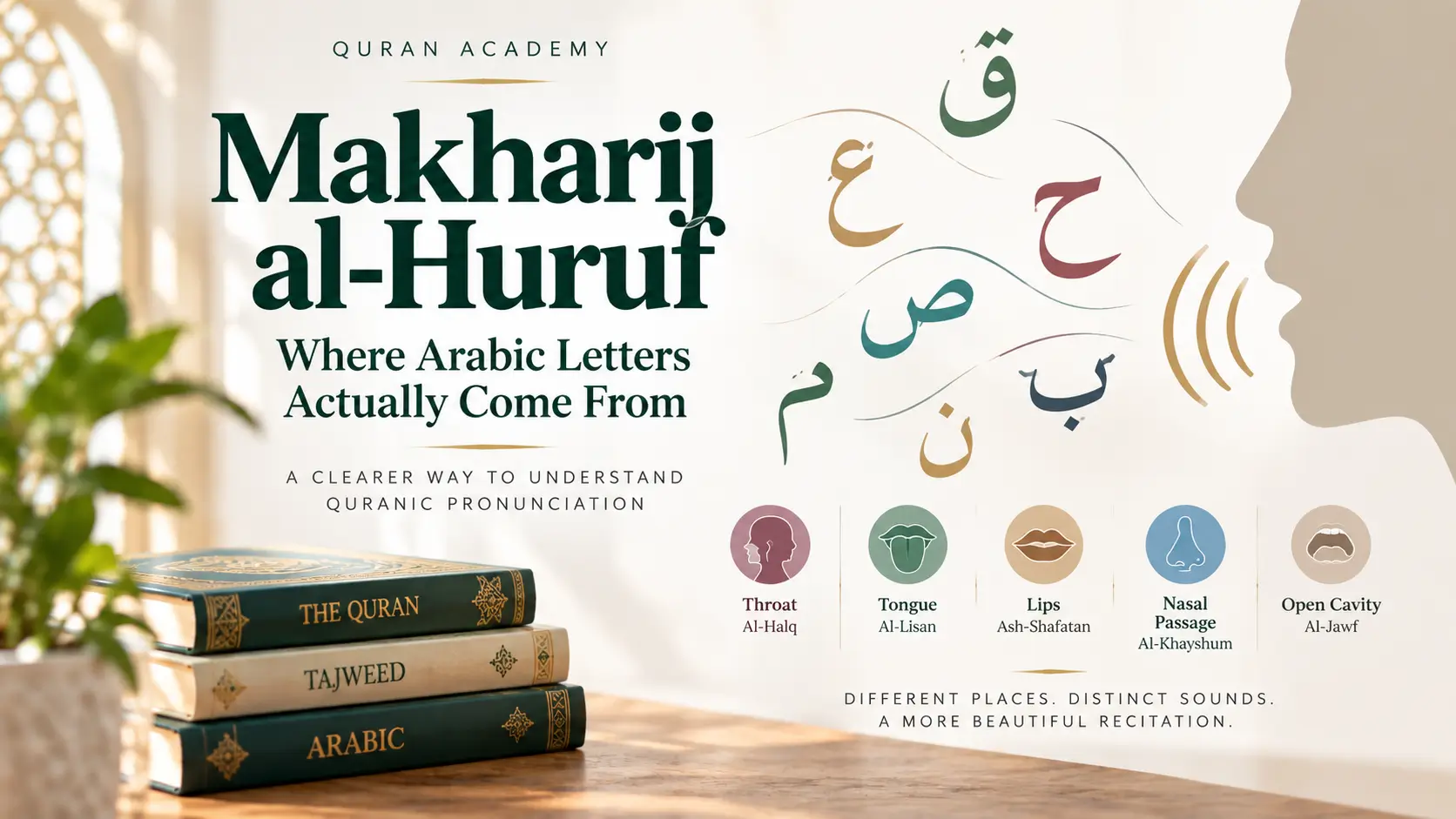
Each Arabic letter is produced through a particular configuration of the throat, tongue, palate, teeth, lips or oral cavity. The study of those articulation points is called Makharij al-Huruf.
Understanding makhraj changes the way you learn Arabic pronunciation.
Instead of repeatedly asking:
“How should this letter sound?”
you begin asking:
“What does my mouth have to do to create this sound?”
That is a much more useful question.
What Does Makharij al-Huruf Mean?
Makhraj (مَخْرَج) means an exit point or place of emergence.
Makharij (مَخَارِج) is its plural.
Huruf (حُرُوف) means letters.
So Makharij al-Huruf refers to the places from which the sounds of Arabic letters emerge.
In the commonly taught Tajweed classification associated with Imam Ibn al-Jazari, the articulation system is organised into 17 specific articulation points within five broader regions:
| Main region | Arabic term | Specific points | What it involves |
|---|---|---|---|
| Open cavity | الجوف — Al-Jawf | 1 | The open space of the mouth and throat |
| Throat | الحلق — Al-Halq | 3 | Different levels of the throat |
| Tongue | اللسان — Al-Lisan | 10 | Back, middle, sides and tip of the tongue |
| Lips | الشفتان — Ash-Shafatan | 2 | The lips and interaction with the teeth |
| Nasal passage | الخيشوم — Al-Khayshum | 1 | Nasal resonance used for ghunnah |
This 17-point system is the most widely taught framework, although scholars have historically differed slightly in how some articulation points are counted or grouped.
But memorising the number 17 does not make someone pronounce Arabic correctly.
The real objective is to learn what those locations feel like when you recite.
Think of Makhraj as a Map of Your Vocal Tract
When children learn the Arabic alphabet, letters are normally organised visually:
ا ب ت ث ج ح خ…
For pronunciation, there is another useful way to organise them.
Imagine moving through the vocal tract from the deepest areas towards the outside:
open cavity → throat → back of tongue → middle of tongue → sides and tip of tongue → teeth → lips
Arabic sounds appear at different points along this route.
That means the alphabet can be understood not only as a sequence of written characters but also as a physical map of sound production.
This becomes particularly useful when two letters are being confused.
Instead of telling the learner:
“That doesn’t sound right.”
a teacher can identify what has physically happened.
Perhaps the tongue moved too far forward.
Perhaps the required throat constriction disappeared.
Perhaps a letter that should be produced from the back of the tongue moved towards the articulation of another letter.
Pronunciation then becomes something that can be diagnosed rather than merely imitated.
The Five Main Makhraj Regions
Al-Jawf: The Open Cavity
Al-Jawf refers to the open cavity of the mouth and throat.
This region is associated with the three madd, or long-vowel, sounds represented by:
ا
و
ي
when they occur in their elongation forms.
Unlike many consonants, these sounds do not depend on one precise point of physical contact between the tongue and another surface.
The sound flows through the open vocal cavity.
This makes Al-Jawf unusual.
With a letter such as ب, you can physically observe the lips coming together.
With ف, you can feel the lower lip approaching the upper teeth.
With a madd sound, there is no equivalent point where two surfaces meet to create the letter.
The cavity itself participates in the sound.
This is why it is useful to think of makhraj not only as:
“Where does the tongue touch?”
but more broadly as:
“Where and how is this sound being formed?”
Al-Halq: The Throat
The throat contains three major articulation areas.
Together they produce six important Arabic letters.
The deepest part of the throat
The deepest throat region is associated with:
ء ه
Hamzah ء and Haa ه therefore arise from the same broad throat level, although they do not sound the same because articulation point is only one part of pronunciation.
The middle of the throat
The middle throat produces:
ع ح
These are particularly important for non-Arabic speakers because many languages do not contain direct equivalents.
A learner may consequently replace ح with an ordinary breathy ه sound.
Similarly, ع may be weakened, replaced with a vowel, or omitted altogether.
But:
ح is not ه
and:
ع is not simply a vowel marker.
They are independent Arabic consonants.
The part of the throat nearest the mouth
This area produces:
غ خ
These sounds are made farther forward than the previous throat groups, near the transition between the throat and the mouth.
The complete throat sequence can therefore be visualised approximately as:
ء ه → ع ح → غ خ
moving from deeper towards nearer the mouth.
Al-Lisan: The Tongue
The tongue is where the map becomes much more detailed.
Ten of the commonly taught 17 articulation points are associated with different parts of the tongue.
This is why simply telling a learner:
“Use your tongue”
does not help much.
Which part?
The back?
The middle?
One side?
The tip?
And what should it approach or touch?
The palate?
The gums?
The upper teeth?
The tongue produces a large proportion of Arabic’s consonantal distinctions.
The back of the tongue: Qaf
ق
is produced using the back area of the tongue towards the upper rear region of the mouth.
For many learners, ق gradually drifts towards:
ك
because both involve the back of the tongue.
But their articulation is not identical.
Slightly forward: Kaf
ك
is also produced with the back of the tongue, but at a position somewhat forward from the articulation of ق.
This gives us an excellent example of why makhraj is useful.
If someone’s ق repeatedly sounds like ك, saying:
“Make the q sound stronger”
may encourage unnecessary force.
A better correction may be:
Move the articulation farther back.
The issue is location, not volume.
The middle of the tongue
The middle of the tongue participates in producing:
ج ش ي
where ي here refers to the consonantal Yaa rather than the long-vowel Yaa of Al-Jawf.
The middle of the tongue rises towards the palate to form these sounds.
The side of the tongue: Dad
One of Arabic’s most distinctive articulation patterns belongs to:
ض
Dad involves the side of the tongue interacting with the upper molar region.
It is therefore very different physically from simply saying a heavy د or a z-like sound.
This is also one reason ض can require significant teacher correction.
The learner may understand intellectually that Dad is different while their tongue continues using the articulation pattern of a sound already familiar from another language.
Lam
ل
involves the forward side/edge region of the tongue with the upper gum area.
Its exact sound can also be affected by other Tajweed principles—for example, the Lam in the name of Allah has rules concerning heaviness and lightness depending on context.
That is a useful reminder that makhraj alone does not describe everything about a letter’s sound.
Noon
ن
is produced using the tip region of the tongue with the area behind the upper front teeth, while Noon can also carry nasal resonance in relevant Tajweed situations.
Raa
ر
is produced from the tip region of the tongue near the upper gums.
A common error is to assume that because Raa involves movement of the tongue tip, it should be dramatically rolled.
Over-exaggeration can be as much a pronunciation problem as under-articulation.
Correct makhraj is about controlled placement, not theatrical force.
Ta, Dal and Taa
The letters:
ت د ط
share the same general articulation point involving the tongue tip and the roots of the upper front teeth.
Yet they clearly do not sound identical.
This becomes extremely important when understanding the limitations of makhraj.
We will return to it shortly.
Saad, Zay and Seen
The letters:
ص ز س
are grouped at another tongue-tip articulation region associated with the lower front teeth and a channel through which the sound passes.
Again, they share a makhraj grouping but have different sound characteristics.
Tha, Dhal and Zaa
The letters:
ث ذ ظ
are produced with the tip of the tongue approaching or extending between the front teeth.
This can be particularly unfamiliar for speakers whose everyday language has merged these Arabic-derived letters into other sounds.
Ash-Shafatan: The Lips
Two articulation points are associated with the lips.
Faa
ف
is produced through the lower lip interacting with the upper front teeth.
This makes Faa one of the easiest makhraj locations to observe in a mirror.
Baa, Meem and Waw
The letters:
ب م و
in their consonantal forms involve the lips in different ways.
ب requires the lips to close and release.
م also involves closure of the lips but with nasal participation.
Consonantal و uses rounded lips without the same closure.
Again, the fact that several letters use the same broad region does not make them the same sound.
Al-Khayshum: The Nasal Passage
Al-Khayshum refers to the nasal passage.
It is associated with ghunnah, the nasal resonance heard with Noon and Meem in particular Tajweed contexts.
This point is slightly different from the others.
There is not an independent Arabic alphabet letter whose entire identity is simply “the nasal letter”.
Instead, the nasal passage provides the resonance for ghunnah.
That distinction is worth understanding because diagrams sometimes make the five regions look as though each contains a separate group of ordinary consonants.
Al-Khayshum is better understood as the outlet through which the nasal quality of ghunnah is heard.
The 17 Articulation Points in One Reference Table
The following is a useful simplified reference.
| Region | Specific articulation area | Letter or sound |
|---|---|---|
| Al-Jawf | Open cavity | Madd ا، و، ي |
| Al-Halq | Deepest throat | ء، ه |
| Al-Halq | Middle throat | ع، ح |
| Al-Halq | Throat nearest mouth | غ، خ |
| Al-Lisan | Back of tongue | ق |
| Al-Lisan | Slightly forward from Qaf | ك |
| Al-Lisan | Middle of tongue | ج، ش، ي |
| Al-Lisan | Side of tongue | ض |
| Al-Lisan | Forward edge/tip region | ل |
| Al-Lisan | Tip region | ن |
| Al-Lisan | Tip region | ر |
| Al-Lisan | Tip with upper front-teeth area | ط، د، ت |
| Al-Lisan | Tip near lower front teeth | ص، ز، س |
| Al-Lisan | Tip at/between front teeth | ظ، ذ، ث |
| Ash-Shafatan | Lower lip with upper teeth | ف |
| Ash-Shafatan | Two lips | ب، م، و |
| Al-Khayshum | Nasal passage | Ghunnah |
This is an excellent reference chart.
But it is not yet pronunciation training.
The Most Important Distinction: Makhraj Is Not the Same as Sifat
This is where many beginner explanations stop too early.
They teach:
“Every letter has a place from which it comes.”
Correct.
But then a learner notices something confusing.
If:
ت د ط
come from essentially the same articulation point, why don’t they sound the same?
Or:
ص س ز
share a makhraj grouping, why is ص noticeably different from س?
The answer is Sifat al-Huruf.
Makhraj answers:
Where is the sound produced?
Sifat answers:
What characteristics does the sound have when it is produced?
Those characteristics can involve things such as airflow, voicing, strength, elevation of the tongue and other qualities.
This gives us a much better model of pronunciation:
Correct Arabic letter = correct makhraj + correct sifat
You need both.
This is also why someone can place their tongue approximately correctly and still produce the wrong letter.
The location may be right.
The sound quality may be wrong.
Arabic emphatic consonants, for example, involve complex articulatory behaviour beyond their primary tongue contact; phonetic research describes secondary pharyngeal or uvular constriction as part of their production.
This leads directly into another important Tajweed concept:
Tafkhim and Tarqiq — heavy and light pronunciation.
We will cover that separately rather than trying to squeeze the whole subject into makhraj.
Two Different Reasons Letters Get Confused
When a learner confuses two Arabic letters, there are at least two fundamentally different possibilities.
Problem 1: The Articulation Points Are Too Close
Consider:
ق / ك
Both involve the rear part of the tongue.
If the learner moves Qaf forward, the sound may begin approaching Kaf.
Here the correction is strongly related to makhraj.
Another example is:
ح / ه
Both are throat-related sounds, but they originate from different throat regions and involve different articulation.
If the learner never develops the middle-throat articulation of ح, it may collapse into ه.
Problem 2: The Letters Share a Makhraj but Differ in Characteristics
Now consider:
س / ص
Their articulation areas are closely grouped within the traditional makhraj system.
If you only teach tongue location, you have not explained why ص has its characteristic fuller, heavier quality.
Similarly:
ت / ط
share an articulation point, yet ط is not merely an unusually forceful ت.
Here the difference requires understanding sifat, including the characteristics responsible for emphatic or heavy sound.
This distinction matters for teaching.
If the teacher diagnoses every pronunciation problem as:
“Your tongue is in the wrong place”
some errors will never be solved.
How Can You Find the Makhraj of a Letter Yourself?
Classical Tajweed teaching uses a useful test.
Give the target consonant a sukoon and place a vowelled Hamzah before it.
Then pronounce the combination and notice where the sound is interrupted or formed.
For example, combinations conceptually like:
أَبْ
أَتْ
أَقْ
allow you to pay attention to the physical point at which the consonant appears.
The point where the sound becomes determined helps reveal the makhraj.
This exercise is particularly useful because vowel sounds can disguise what the tongue or lips are doing.
Putting the consonant into sukoon makes its articulation easier to isolate.
The madd letters are different because their articulation is associated with the open cavity rather than a fixed contact point.
Don’t Just Listen to a Letter — Feel It
A beginner often learns pronunciation almost entirely through hearing:
Teacher says it.
Student repeats it.
That is necessary.
But adding physical awareness can make correction much faster.
When practising a letter, ask three questions.
Where?
Where in the vocal tract is the sound being formed?
Throat?
Back of tongue?
Middle?
Tip?
Lips?
What touches or approaches what?
Does the tongue touch the teeth?
Does the side of the tongue contact the molars?
Do the lips close?
Is there no fixed contact at all?
What does the sound feel like?
Does the air continue?
Does the sound stop?
Is there nasal resonance?
Does the back of the tongue rise?
This creates what we might call a three-layer pronunciation model:
location → movement/contact → sound quality
That is significantly more useful than simply memorising:
“Qaf comes from the tongue.”
The Isolation Trap: “I Can Say the Letter Correctly on Its Own”
Another common problem appears after the learner successfully learns a makhraj.
Ask them to say:
ق
alone.
Perfect.
Then ask them to read a Quranic word containing Qaf.
The old pronunciation returns.
Why?
Because pronunciation has two stages.
The first is isolated control.
The second is automatic application during connected reading.
When a learner recites a word, the brain is simultaneously dealing with:
- recognising letters,
- processing harakat,
- blending,
- remembering madd,
- anticipating the next sound,
- and maintaining fluency.
A newly corrected makhraj can disappear under that cognitive load.
This does not necessarily mean the learner “doesn’t know” the pronunciation.
It means the pronunciation has not yet become automatic.
The practice progression should therefore be:
letter alone
↓
letter with different harakat
↓
short combinations
↓
unfamiliar words
↓
Quranic words
↓
connected recitation
A pronunciation correction has not fully transferred until it survives normal reading.
A Better Way to Practise Difficult Letters
Repeating one letter fifty times can help build physical familiarity.
But there is a more useful progression.
Stage 1: Locate
Learn where the letter is produced.
Say it slowly.
Notice the tongue, throat, teeth or lips.
Stage 2: Contrast
Practise it beside the letter you normally confuse it with.
For example:
ق / ك
or:
ح / ه
or:
س / ص
The goal is not simply to say both.
The goal is to notice:
What physically changes when I move from one to the other?
Stage 3: Transfer
Place the target sound into:
- different vowel combinations,
- different positions,
- unfamiliar words,
- and eventually Quranic text.
That final stage matters enormously.
Being able to perform a makhraj exercise is useful.
Being able to preserve that makhraj while reciting Quran is the actual objective.
Why Transliteration Can Hide Makhraj Problems
English transliteration often has to approximate Arabic sounds.
Consider:
ه
and:
ح
Both may appear as some version of “h”.
Or:
س
and:
ص
may both appear to an inexperienced reader as some version of “s”.
Or:
ت
and:
ط
as variations of “t”.
Special transliteration marks such as:
ḥ, ṣ, ṭ, ʿ
help distinguish them on paper.
But they still cannot teach the physical articulation.
A symbol such as ḥ essentially tells you:
“This is not ordinary h.”
It does not tell your throat how to produce ح.
This is why transliteration is useful as notation but weak as a pronunciation teacher.
The learner eventually needs the direct connection:
Arabic letter → Arabic articulation
without passing through an English substitute.
Why Urdu Readers Need to Be Particularly Careful with Makhraj
Someone who already reads Urdu may have a major advantage when beginning Quran reading.
The script is familiar.
Many letter shapes are familiar.
Joining patterns are familiar.
But pronunciation creates an interesting problem.
Several distinct Arabic letters have merged into the same or similar everyday Urdu sounds.
For example, standard Urdu commonly pronounces:
ث like an s sound,
ص like س,
ذ، ض and ظ with z-type pronunciations,
and ط like ت.
Urdu ح is also commonly realised much more like an ordinary h than its Arabic pronunciation. The University of Texas Urdu pronunciation guide documents these standard Urdu patterns.
That means an Urdu reader may look at:
ص
and know perfectly well that the letter is Saad.
But the mouth automatically retrieves the Urdu pronunciation associated with the written symbol.
This is a different problem from not knowing the alphabet.
The learner does not need to learn what the letter looks like.
They need to separate Quranic Arabic pronunciation from an existing Urdu pronunciation habit.
This is why, for many Indian learners:
the eyes may be ahead of the mouth.
And it is exactly why makhraj training can be particularly valuable even for someone who has read an Arabic-derived script for decades.
Five Common Makhraj Problems Beginners Develop
Replacing an Unfamiliar Arabic Sound with the Nearest Familiar Sound
The brain naturally searches for an existing sound category.
So:
ح becomes h.
ق becomes k.
ص becomes s.
This is understandable.
But the solution is to build a new sound category rather than continually modifying the familiar one.
Adding Too Much Force
After being told a letter is “strong” or “heavy”, learners sometimes compensate by squeezing the throat, raising the volume or exaggerating the sound.
Heaviness is not the same as loudness.
And correct articulation should not require unnecessary physical strain.
Correcting the Letter but Losing It Inside Words
The makhraj has been consciously learned but not automated.
This requires transfer practice rather than another theoretical explanation.
Hearing No Difference Between Two Letters
Sometimes the mouth cannot reliably produce a distinction because the ear has not yet learned to notice it.
Contrastive listening can therefore be useful.
Listen repeatedly to:
س / ص
or:
ه / ح
and learn to recognise the difference before expecting perfect production.
Knowing the Makhraj Description Without Producing It
A student can memorise:
“Dad comes from the side of the tongue.”
and still pronounce Dad incorrectly.
Knowing anatomy is not the same as building a motor skill.
Makhraj knowledge must become physical.
How Can Parents Tell Whether a Child Has a Pronunciation Problem?
Parents do not need to diagnose specific Tajweed errors themselves.
But certain patterns are worth noticing.
A child may need focused pronunciation work if:
- the teacher repeatedly corrects the same Arabic letter,
- several different letters sound almost identical,
- the child can name the correct letter but gives another letter’s sound,
- pronunciation changes noticeably when reading faster,
- or the child relies on familiar Hindi, Urdu or English sounds for Arabic letters.
The useful question to ask the teacher is not merely:
“Is the pronunciation good?”
Ask:
“Which letters are still unstable, and what exactly is the child doing instead?”
A useful answer might be:
“The child recognises Qaf but is moving the articulation forward so it sounds closer to Kaf.”
That tells you far more than:
“He needs more Tajweed.”
Should Beginners Learn All 17 Makharij Before Reading the Quran?
Not necessarily as a memorisation exercise.
A six-year-old does not need to pass a written examination naming every articulation point before being allowed to read.
What matters from the beginning is establishing reasonably correct sound habits.
A child can first learn:
This is ح. Listen. Watch. Try it from here.
Later they can learn:
ح comes from the middle throat and belongs to Al-Halq.
The physical skill can begin before the terminology is fully memorised.
For older students and adults, understanding the system explicitly may speed up correction.
The best sequence depends on the learner.
Can an App Teach Makharij?
An app can do several useful things.
It can provide:
- high-quality pronunciation models,
- repeated listening,
- diagrams,
- slow examples,
- comparison exercises,
- and unlimited repetition.
What it cannot always do reliably is identify precisely what your tongue or throat did incorrectly.
That distinction is important.
A recording can show you the target.
A teacher can compare the target with your actual production.
For makhraj, that feedback loop is particularly valuable because learners often cannot hear their own errors.
Makhraj Is the Beginning of Correct Pronunciation, Not the Whole of Tajweed
Learning the articulation points can dramatically improve Quran pronunciation.
But makhraj is not the entire science of Tajweed.
A learner may know where every Arabic letter is produced and still need to study:
- Sifat al-Huruf,
- Tafkhim and Tarqiq,
- Madd,
- Ghunnah,
- Noon Sakinah and Tanween,
- Meem Sakinah,
- Qalqalah,
- stopping and starting,
- and other recitation rules.
That is not a weakness in the makhraj system.
It simply reflects an important distinction.
Makhraj tells us where the letter begins.
Other Tajweed principles tell us what happens to the sound during recitation.
Allah says:
“…and recite the Quran properly in a measured way.”
— Quran 73:4
Clear recitation begins with giving the letters their distinct identities.
A Better Way to Think About Arabic Pronunciation
When a teacher corrects a letter, try not to hear the correction as:
“My Arabic sounds bad.”
Instead ask:
What physical adjustment produces the correct letter?
Perhaps:
move the tongue back
or:
bring the tongue tip forward
or:
use the middle throat rather than an ordinary h
or:
let the lower lip meet the upper teeth
or:
keep the makhraj but change the quality of the sound
That turns pronunciation from imitation into understanding.
And once a learner begins seeing Arabic letters this way, the alphabet changes.
It is no longer only:
28 shapes on a page.
It becomes a map stretching from the deepest parts of the throat to the lips.
The learner can see a letter—
and begin to know where in the body that letter should come alive.
Frequently Asked Questions
What Are Makharij al-Huruf?
Makharij al-Huruf are the articulation points from which Arabic letter sounds are produced. They involve regions including the open oral cavity, throat, tongue, lips and nasal passage.
How Many Makharij Are There?
The most commonly taught Tajweed classification uses 17 specific articulation points grouped within five main regions: Al-Jawf, Al-Halq, Al-Lisan, Ash-Shafatan and Al-Khayshum. Other historical counting systems group some points differently.
What Are the Five Main Makharij Regions?
They are Al-Jawf (open cavity), Al-Halq (throat), Al-Lisan (tongue), Ash-Shafatan (two lips) and Al-Khayshum (nasal passage).
What Is the Difference Between Makhraj and Tajweed?
Makhraj concerns where a letter is articulated. Tajweed is broader and includes articulation as well as letter characteristics, elongation, nasalisation, stopping rules and other principles governing Quran recitation.
What Is the Difference Between Makhraj and Sifat?
Makhraj describes where a letter is produced. Sifat describe the characteristics of that sound. Two letters can therefore share an articulation point but remain different because their characteristics are different.
Which Arabic Letters Come from the Throat?
The six commonly classified throat letters are:
ء، ه، ع، ح، غ، خ
They are divided across three throat regions.
Which Letters Are Commonly Difficult for Beginners?
The exact difficulty depends on the learner’s first language, but throat letters and emphatic Arabic consonants frequently require focused practice because many languages do not contain equivalent sounds. Arabic emphatic consonants also involve articulatory complexity beyond a simple tongue contact.
Why Does My Qaf Sound Like Kaf?
Qaf and Kaf are both produced using the rear part of the tongue but from different positions. If Qaf moves too far forward, it can begin approaching Kaf. A teacher can help correct the exact tongue placement.
Why Does My Saad Sound Like Seen?
Saad and Seen share a closely related articulation region, so the problem may not primarily be makhraj. Their sound characteristics differ, including the emphatic quality of Saad. This is why learning Sifat al-Huruf matters alongside makhraj.
Can I Learn Makharij Without a Teacher?
Diagrams, recordings and exercises can teach a great deal about articulation. A qualified teacher is particularly useful for detecting errors the learner may not hear in their own pronunciation.
Should Children Memorise All 17 Makharij?
Children should develop correct pronunciation habits, but memorising all the terminology is not necessarily the first priority. Younger learners can develop articulation through listening, imitation and correction while the formal system is introduced progressively.
I Read Urdu Fluently. Do I Still Need to Learn Makharij?
Possibly, and often for a different reason than a complete beginner. Urdu readers usually have a substantial advantage in recognising the script, but several distinct Arabic letters are pronounced alike in standard Urdu. Quranic Arabic pronunciation therefore requires separating those familiar Urdu sound patterns again.
